Skills That Matter
AI rewards a tech-forward, learning orientation. We share our perspective, in mid-2026, on what maximizes your effectiveness personally and professionally. Spoiler: use AI, but well. Be aware of the costs, and how, in some ways, being human (still) matters more now than ever.

A note on timing: this was written in May 2026, and like most of what we say about AI, we mean it as true for now and likely to change. We see no known ceiling on what these systems can do, as today’s technology scales and as new methods arrive, and we expect them to keep improving fast. So the specific weaknesses we name below will probably soften over time. The willingness and ability to adapt and keep learning will likely remain a key capability for some time.
These tools, for better or worse, advantage the people who take advantage of them. Naturally, that can look like a certain profile of person: tech-forward, curious about the frontier, comfortable with change. If that is you, good, you are probably well-oriented for the modern world. For those who at times need a bit more encouragement to embrace something new, we encourage you to be open-minded and change-comfortable. AI is powerful enough that being a laggard in adoption may be incomparably costly to your ability to engage as society continues to integrate with this new(ish) intelligence we have created. None of this requires you to be a “tech person.” It may just mean that, if these things are not your natural orientation, you will have to push yourself a little harder. That is a fair price.
We have already made the case that the technology is incomparably powerful, and that this is not really arguable, which is a distinct question from the genuine uncertainty about the exact pace and size of the economic and societal effects. Take the power as the starting point. For the last two years we have invested heavily in AI, and while we have the battle scars to prove it, many of us are having the most fun we have ever had professionally.
One distinction worth stating plainly before we go further: when we talk about how powerful these tools are, we mostly mean the agentic versions. Not a chat window that answers a question, but a system you can hand a goal and a little direction, that will then carry out many steps on its own, write and run code, use other software, check its own work, and keep going. The chatbot is the small, familiar corner. The agent that takes a task and runs with it is the part reshaping how work gets done. Everything below assumes that is what you are reaching for. If agents are newer to you, we wrote a primer on where to start and how to add complexity only as the value justifies it.
The door is open, but you have to walk through it
The single most important shift is also the simplest to state: building things stopped being a specialized act. Designers open terminals. Project managers ship working prototypes to test an idea before engineering is involved. A proposal that used to take two weeks gets built in a day, dictated by voice at close to 200 words a minute while walking the dog (at times).
None of that requires a computer science degree. It requires the willingness to try new things, and the patience to keep trying when you encounter obstacles. So the baseline skill is not technical. It is adaptability, and an appetite for learning that does not switch off. If you have those, the rest is learnable. If that is not your default orientation, lean into whatever helps you overcome it, because there will be setbacks and disappointments. Like life.
How to optimize
Say you are in. You are using the tools daily. Here is what we have found maximizes your impact, in roughly the order we would rank it. Treat it as a menu of habits, not a checklist, and assume it shifts as the models do. This is our perspective as of today.
Parallelize. This is the biggest unlock, and it asks you to reconfigure how you work in one of two ways. The first: run more different kinds of things at the same time. While an agent drafts a proposal, another researches a prospect, a third builds a prototype, and you direct and decide across all of them. That demands real organization: being deliberate about what is short-term scratch versus what needs to persist, and about how you keep each agent moving without losing the thread. The second: if you are heads-down on a smaller set of projects, get good at breaking them into pieces that can run at once. We used to think strictly in sequence, A then B then C then D. The new playbook is A, B, C, and D in parallel, which means you get to E, F, G, and H tomorrow instead of next week. This is not old-fashioned multitasking. It is closer to conducting. And it has a hard limit, which is you. As Addy Osmani puts it, your cognitive bandwidth does not parallelize even when the agents do: the machine generates, but you still do all the evaluating, deciding, and integrating.6 Our own comfortable ceilings vary a lot, from three or four threads to around ten on a good day. Part of the skill is knowing yours and not blowing past it.
Develop discernment about the output. AI is fluent, fast, and confidently wrong. The skill is not generic distrust. It is a calibrated, earned sense of where a given tool tends to fail: where it hallucinates, where it is overconfident, where it quietly leads you astray. You build that by doing the work and paying attention to the misses, then putting corrective measures in place for the patterns you have seen. A concrete move we lean on: make the model explain and defend its choices, especially on work outside your own expertise. If it cannot justify a decision in terms you understand, that is your signal to slow down. And because building is suddenly so cheap, you can afford to build far more checking around the work than you used to: tests, validations, and guardrails that catch the confident mistake before it ships.
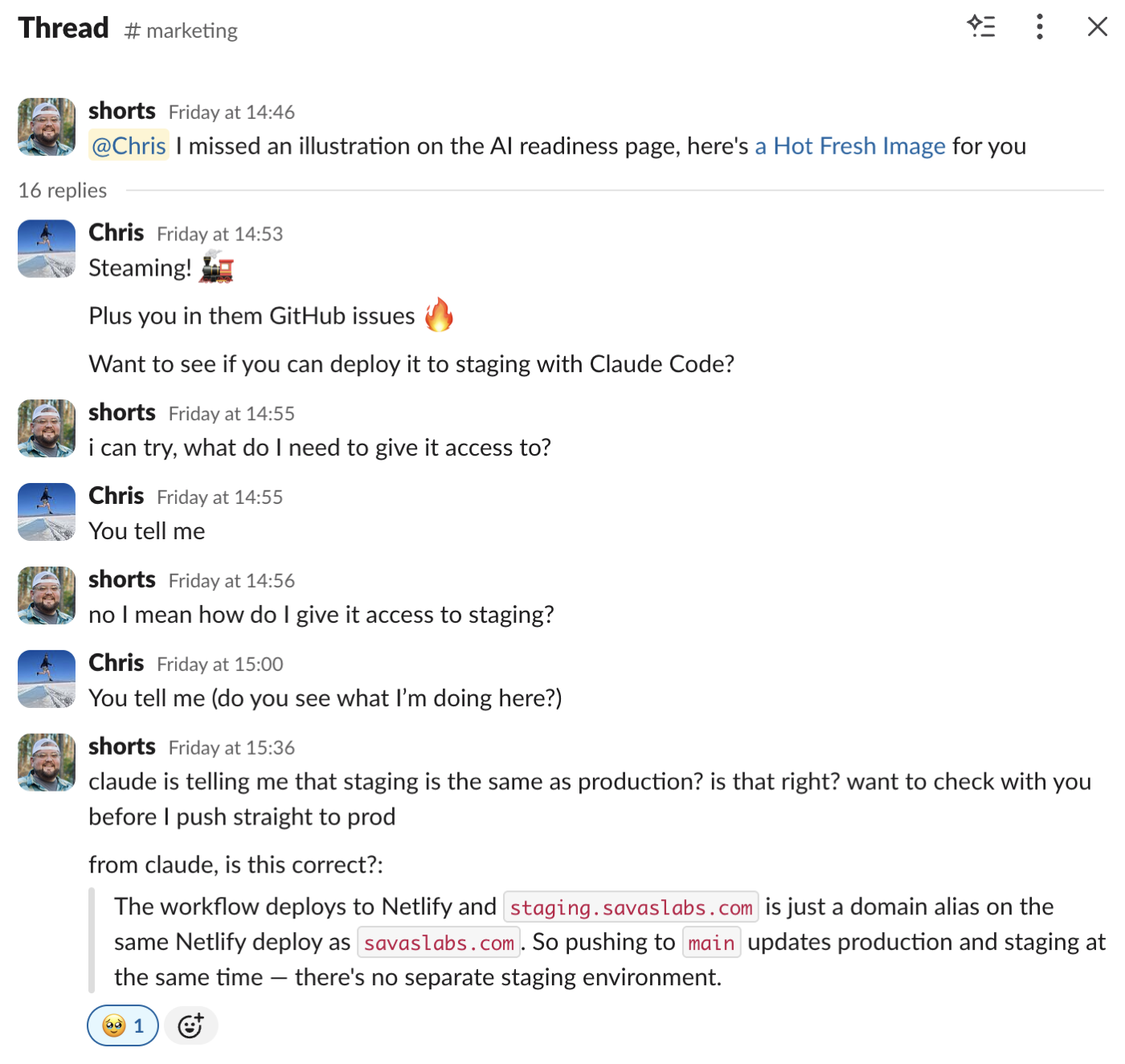
Build a conceptual model of how these tools work. Not at the level of syntax. You do not need to know how to write a database from scratch. But it helps enormously to understand, broadly and conceptually, how these systems behave, because one of the most powerful things about them is that you can simply talk to them. They will help you troubleshoot, explain what they are doing, and meet you where you are. In the last month a designer, a salesperson, and a marketing teammate each shipped code to our production website, not by learning to code, but by giving an AI agent access and conversing with it toward the goal. Here is one of those moments: a designer deploying the new AI-readiness hero image by talking to Claude Code, with a little Socratic nudging.
Trade depth for breadth. This shift cuts across roles, not just engineering. Some skills that mattered a great deal are quietly worth less now: memorizing syntax, deep mastery of one specific stack, raw output speed, the accumulated tribal knowledge of a single technology. What rises in value is range: the ability to move across problems and pick up whatever the task needs. One line worth holding, though: it is specialization that is fading, not understanding. You still cannot verify, or safely debug, what you could not have reasoned through yourself. The hype version of this (“nobody needs to learn the fundamentals anymore”) is wrong in a way that will cost people. Fundamentals are what let you catch the confident mistake.
Then get your direction in fast. Once the habits above are working, the ceiling moves to a surprising place: how quickly you can give clear direction. This is where the speed demons live. Voice dictation is the cheapest upgrade most people are not using, because you can talk to these tools far faster than you can type to them. At that point you are limited mostly by how fast and how good your direction is, and by how aware you are of what context the model needs. That last part is largely tool familiarity, and it keeps getting easier as the models get better at asking for what they are missing.
A few more habits that matter and resist neat description: stay tool-agnostic, because the best option today may be second-best next month; tend your context carefully, but distrust it too, since a stale note will confidently mislead; know which system holds the real answer; know when a thing is actually done, because the model will always offer one more improvement; and keep a working mental model of version control so you can always get back to safe ground.
The honest cost
Working this way has a downside, and it is not minor. Moving fast across many threads fragments your attention in a way the human brain did not evolve to handle. Average sustained attention on a screen has fallen to something like 47 seconds.1 And speed hides errors. The most telling data we have seen: when teams adopt AI coding assistants, trivial syntax mistakes drop sharply while the dangerous, structural problems rise. One study found architectural design flaws up over 150 percent even as easy-to-catch errors fell.2 The mistakes do not go away. They get quieter, and harder to see.
There is a deeper cost. When creation is frictionless, you stop slowing down to struggle, and struggle is where learning lives. Decades of research on “desirable difficulties” shows that the conditions that make learning feel harder are often the ones that make it stick.4 Early evidence on heavy AI use points the same direction: in one MIT study, people who leaned on a chatbot to write showed weaker neural engagement and had trouble recalling their own work, what the authors call cognitive debt.3 It is a small, early study, and worth not overstating. But it matches something we feel. Some of us have noticed less patience for sitting with a hard piece of reading, because we half-expect the tool to do the sitting for us. That patience is worth fighting to keep. It is suddenly easy to make something work and not be able to retrace how, or to trigger something you did not fully understand. The fix is not to go slower for its own sake. It is to stay close enough to the work that you could explain it.
Why being human is totally in again
Here is the turn, and it is the genuinely hopeful part. As the machine absorbs more of the execution, the distinctly human work becomes the bottleneck and the differentiator. Asking the question that saves a week of building the wrong thing. Understanding what someone actually needs versus what they asked for. Reading a room. Building trust. Being informal and real in a way that lowers the distance between people. These were always valuable. They are worth more now, and for a slightly uncomfortable reason: we are increasingly surrounded by competent, human-like output that is not actually human, and is not as rewarding to be on the receiving end of. Genuine connection stands out more against that backdrop, not less. The U.S. Surgeon General has described social disconnection as carrying a mortality risk comparable to smoking 15 cigarettes a day.5 We are wired for the real thing, and the real thing is getting scarcer.
This shows up in how we hire. We have always been oriented toward people who are good with other people, and we are even more so now: relationship builders, people who read humans well, people who are simply good to work with. For the foreseeable near term we are still building products primarily for humans, and humans are still the ones making the financial decisions. (We will note lightly that even this may shift sooner than most expect. There are serious, technical people, the kind who debate whether autonomous agents already deserve a say, who take agent decision-making seriously today. Worth keeping half an eye on.)
There is a harder edge to this, and we will say it carefully because the data is still settling. Experience plus relational skill is now a multiplier: a senior person with good judgment and good relationships can use these tools to do the work of several, which is exactly what we have watched happen on our own team. The flip side is that it has gotten genuinely harder for people early in their careers. Recent-graduate unemployment has climbed above the national rate, and one Stanford study found a 16 percent relative decline in employment for 22-to-25-year-olds in the most AI-exposed jobs.7 We are not claiming AI caused that on its own. Careful work from the Cleveland Fed notes the erosion of the young-graduate advantage actually began decades ago.8 But the pattern is consistent with something real: AI substitutes most easily for the codified, learn-it-from-a-book knowledge that junior roles have traditionally rewarded, while it complements the tacit knowledge, judgment, taste, relationships, that you only get from experience. If you are early in your career, the lesson is not despair. It is to invest deliberately in the parts that do not come from a textbook.
Keep paying attention
So that is the shape of it. The tools reward a learnable orientation, not a birthright. If you are in, a set of concrete habits compounds your impact, and they will keep changing. There is a real cost in attention and in depth that you have to manage honestly. And the oldest skills, the human ones, did not get cheaper. They got scarce, and scarce things get valuable.
The one instruction that survives every version of this: keep paying attention. To the tools, to your own mistakes, and to the people, who are still the point.